Garden Care Guide · Updated October 2026
Short Answer
For pruning branches higher than about 6 feet (2 m), use a pole saw — you can finish the job standing safely on the ground, with no ladder involved. For ground-level cutting, felling small trees, or splitting firewood, use a chainsaw. Two numbers decide which tool you need: branch height and branch diameter.
Most homeowners buy the wrong tool not because the tool itself is bad, but because they never measured their own yard. This guide gives you a simple “pole saw or chainsaw?” decision framework, plus the practical details that actually matter: reach, bar length, safety, and maintenance.
1. What’s the Difference Between a Pole Saw and a Chainsaw?
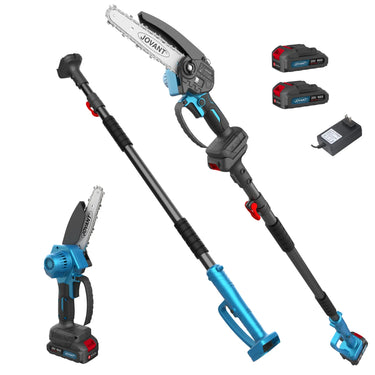
A pole saw is a saw head mounted on an extendable pole, and its defining spec is reach — how high you can safely cut while keeping both feet on the ground. A chainsaw is a handheld saw with much more cutting muscle, and its defining spec is power — how thick a trunk it can handle, and how quickly it fells trees or processes firewood.

Assembling the pole saw on site
2. For High Branches: Pole Saw or Chainsaw?
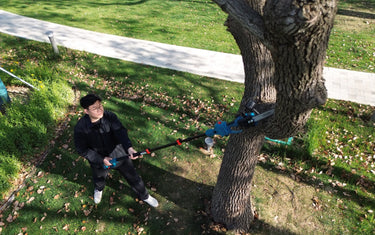
Choose a pole saw. The extendable pole lets you trim branches above 6 feet from the ground, removing the need to climb a ladder — and the fall risk that comes with it. Today, battery-powered models account for more than 70% of new electric pole saw sales in North America and Europe, driven mainly by noise regulations and convenience.

Pole saw working on high branches from the ground
3. How Do I Calculate Reach?
Actual reach = your height + your raised-arm length + the pole length. Most guides only quote the pole length, which underestimates how high you can actually cut.
Before you buy: measure the highest branch you need to reach, then work backward to the pole length you need. Sometimes just 2 feet less pole length can mean the difference between reaching that branch and not reaching it at all.
4. How Does Bar Length Affect What I Can Cut?
The longer the bar, the thicker the branch it can handle. Bar length directly sets the upper limit on branch diameter you can cut through.
A common mistake is buying a 6-inch-bar model to save money, only to find it struggles with the thicker limbs in a mature yard. If your trees are older with thicker branches, go straight to a 10–12-inch model.

Holding a cordless chainsaw for ground-level cutting
5. What About Branches Thicker Than 4 Inches?
Use a pole saw with a 10-inch-or-larger bar, or switch to a chainsaw. Entry-level pole saws with 6–8-inch bars struggle badly on branches over 4 inches (about 10 cm). For repeated heavy work, a chainsaw is the right tool — but only at or below shoulder height, where you can safely control it. For thick branches up high, a pole saw with a 10-inch-or-larger bar can dramatically improve both your efficiency and your cutting experience.
6. Are Brushless Motors and Multiple Batteries Worth It?
Yes. Brushless motors run cooler, last longer, and deliver more torque per watt than brushed motors. Swappable batteries let you keep working without downtime, and a dual-battery kit (for example, 2 × 4.0Ah) typically gives you around 120 minutes of run time — the current standard for mid-to-high-end models.

Keeping the chain properly oiled
7. How Do I Cut Thick Branches Safely?
For any branch thicker than about 3 inches, use the three-cut method to avoid tearing the bark:
Undercut — cut upward about one-third of the way through the branch.
Relief cut — cut again slightly further out so the branch breaks cleanly.
Collar cut — trim the stub flush at the branch collar.
Three safety rules that never bend: never stand directly under the branch; stay at least 10 feet (about 3 m) away from power lines; and clear the drop zone of all people, pets, and vehicles before every cut.

Close-up of the bar and chain in action
8. Maintenance and Storage
Keep the chain tensioned and oiled — a sharp, well-lubricated chain cuts faster and is far safer than a dry one. After each use, clean the bar and chain, then store the saw in its carry bag to protect the bar and keep the battery stored safely.

Stored neatly in its carry bag
FAQ
Q: Do I need a pole saw?
A: Only if you prune high branches more than twice a year. Every job that would otherwise send you up a ladder is a fall risk a pole saw eliminates — the safety value usually outweighs the purchase cost.
Q: How thick a branch can a pole saw cut?
A: It depends on the bar length. An 8-inch bar handles branches up to about 4 inches; a 12-inch bar handles 5–6 inches (about 12–15 cm).
Q: Why can’t I cut branches as thick as the bar length?
A: Not the whole bar is usable for cutting — the nose sprocket cannot enter the wood, and a long pole means less stable high work and higher kickback risk. That’s why the recommended cutting diameter is far smaller than the bar length: an 8-inch bar is recommended for 4-inch branches, and a 12-inch bar for 5–6-inch branches.
Q: Corded or cordless?
A: For yard work, go cordless: no cord to trip over, better mobility, and modern brushless battery saws have more than enough run time for a weekend job.
Q: Can I use a pole saw while standing on a ladder?
A: No. Never use a pole saw from a ladder — if you still need a ladder, the branch is beyond the tool’s safe working range, and combining the two is how fall accidents happen.
Data Sources
The cordless pole saw market was valued at $1.8 billion in 2025 and is projected to reach $3.4 billion by 2034 (Dataintelo, 7.3% CAGR). Battery models account for more than 70% of new electric pole saw sales in North America and Europe (industry estimates).