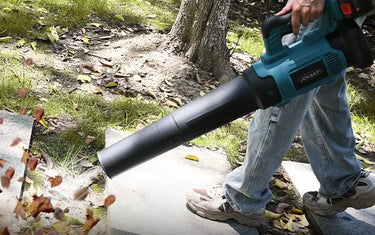
For homeowners and landscaping professionals, the familiar scream of a gas-powered leaf blower is giving way to the quieter hum of electric alternatives.
But within the electric realm, a crucial question arises: Do battery-powered leaf blowers pack the same punch as their corded electric cousins? Let's clear the air.
1. The Power Players: Understanding the Metrics
① Air Volume (CFM - Cubic Feet per Minute):
Measures how much air the blower moves. Higher CFM means moving larger piles or wet debris more effectively.
② Air Speed (MPH - Miles per Hour):
Measures how fast the air exits the nozzle. Higher MPH provides greater force to dislodge stubborn debris stuck in corners or grass.
③Power Source & Efficiency:
Corded models draw continuous, consistent power directly from an outlet. Battery models rely on stored energy, with power potentially dipping as the battery depletes.
2. The Power Showdown: Battery vs. Corded Electric
① Raw Power Output (Peak Performance):
1) Corded Electric:
Historically held the crown. Unrestricted by battery capacity, they can utilize stronger motors, consistently delivering higher maximum CFM and MPH figures. Top corded models easily surpass 600 CFM and 200 MPH.

2) Battery-Powered:
Have made HUGE strides. High-end commercial-grade battery leaf blowers (using 80V, 82V, or dual-battery systems) now rival or even exceed the power of many corded models.
However, maintaining this peak power throughout the battery charge can be a challenge, especially under heavy load or as the battery drains. Mid-range and entry-level battery models often have significantly lower power than comparable corded units.
② Consistency of Power:
1) Corded Electric:
Delivers absolutely consistent power as long as it's plugged in. Performance doesn't waver.
2) Battery-Powered:
Performance can fluctuate. Peak power is often available with a fresh battery, but airflow and speed may decrease noticeably as the battery level drops, especially during demanding tasks or when using lower-capacity batteries. Higher Ah (Amp-hour) batteries help mitigate this.
③ Real-World Effectiveness:
1) Corded Electric:
Unmatched for sustained, heavy-duty tasks on large properties. Ideal for clearing vast amounts of wet leaves, thick mulch, or gravel from large driveways and commercial landscapes. The constant high power is their forte.
2) Battery-Powered:
Excel in mobility and convenience, free from cords. High-end models are incredibly powerful and tackle most residential jobs (clearing dry leaves, grass clippings, patios, driveways, walkways) with ease, often matching corded performance for these tasks.
They shine for quick cleanups, uneven terrain, and areas far from outlets. However, for continuous, maximum-power blasting over long periods, the cord still has an edge, especially if backup batteries aren't on hand.
④ Side-by-Side Comparison Table
| Feature | Corded Electric Leaf Blower | Battery-Powered Leaf Blower |
|---|---|---|
| Peak Power (CFM/MPH) | High (up to 650 CFM / 230 MPH) | Mid to High (up to 600 CFM / 200 MPH on premium models) |
| Power Consistency | 100% consistent | Slight drop as battery drains |
| Runtime | Unlimited (when plugged in) | 15–60 minutes per charge |
| Mobility | Limited by cord length | Unrestricted |
| Best For | Large yards, heavy wet debris, continuous use | Small to medium yards, quick cleanups, hard-to-reach areas |
| Noise Level | 65–90 dB | 60–85 dB (often quieter) |
| Maintenance | Low | Low (just battery care) |
| Weight | Light to medium | Lightest (especially modern lithium-ion models) |
3. The Verdict: It's Complicated (But Battery is Catching Up Fast!)
① High-End Battery vs. Corded:
The gap has dramatically narrowed. Top-tier battery blowers now offer power truly comparable to many corded models, often exceeding them on paper specs.
They are powerful enough for the vast majority of residential and even many commercial landscaping tasks. For sheer mobility, they win hands-down.
② Mid/Low-End Battery vs. Corded:
Corded electric blowers generally offer significantly more power per dollar spent. If raw, sustained maximum power is your absolute top priority on a budget, corded is likely still the choice.
③ The Cord Factor:
Never underestimate the freedom of cordless operation. Tangle-free movement around trees, furniture, and garden beds is a massive advantage for battery blowers, even if absolute peak power might be very slightly less consistent than corded under extreme duress.
 4. Conclusion: Power Isn't Everything (But Battery Has Plenty)
So, are battery blowers as powerful as electric corded ones? For the best battery models: Absolutely yes, and often more powerful than many corded options available.
The technology has advanced remarkably. While corded models maintain a slight theoretical edge in delivering utterly unwavering peak power for hours on end (if you have an outlet nearby), the reality is that modern high-voltage battery blowers deliver phenomenal power that meets or exceeds the needs of most users.
5. When choosing, consider:
① Your Property Size & Task Demands:
Large areas with heavy, wet debris? Long runtime needs? Prioritize high-end battery or corded. Standard residential cleanup? Battery is king.
② Mobility Needs:
Do you have many obstacles, different levels, or areas far from outlets? Battery wins.
The future is cordless. JOVANT Battery leaf blower power has reached levels that make them genuine contenders, offering a compelling blend of impressive force and unmatched convenience that satisfies most users' needs.
Unless you have truly extreme, sustained blasting requirements, a high-quality battery blower is likely the powerful and liberating choice.