
(and What Insurance Won't Cover)
Short answer: most homeowners policies pay to remove a fallen tree only when it damaged something insured — the house, an attached garage, a shed, a fence, or a vehicle. A limb lying on open lawn is usually your bill. You can take a limb down yourself when it is already on the ground, under no tension, and about 4 inches in diameter or less. Bigger than that, still attached to the tree, or anywhere near a power line, is a job for a professional.

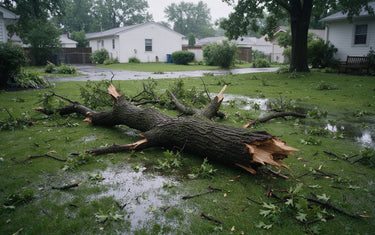
A storm-damaged limb on a wet lawn the morning after — where every coverage decision starts.
What does homeowners insurance actually cover after a storm?
The adjuster is not asking whether a tree fell. They are asking what it hit. Coverage follows the damage, not the weather.
· House and attached garage: usually covered. Removal is paid as part of the claim, but often under a separate sub-limit.
· Detached shed, fence, vehicle: usually covered, same logic.
· Open lawn and garden beds: usually not covered. Nothing insured was damaged, so clearing the debris counts as routine yard maintenance.
· Driveway blocked, nothing else: depends on your policy wording. Some endorsements cover necessary access; most require structural damage first.
· Limb still hanging in the tree: usually not covered. That is preventive pruning, not a sudden loss.
· Anything touching a power line: not a DIY situation at all. Call the utility.
Storm damage tree limb cleanup is priced by size and access, not by the number of branches — which is why the coverage question matters more than the tree itself.

The same rules as a picture. Usually covered on the left, usually not on the right.
How much will the payout actually cover?
Removal is often capped separately from the structure. Triple-I's own example is a $500 limit on tree removal when a tree damages the roof. Ask three questions on the phone before you sign anything: what is the limit, what is the deductible, and does the payout follow the full quote or only the minimum needed to protect the property.

A limb on the roof and a limb on the grass run two completely different claims.
What should I photograph before I touch anything?
Ten minutes with a phone protects the claim. Once the yard is clean, the damage scope is gone.
1. One wide shot: the whole tree, where it landed, how it sits against the house.
2. Close shots: the break, the torn bark, the crushed gutter or shingles.
3. Structural detail: vertical cracks in the trunk, soil heaved up around the root plate.
4. Keep the originals: no cropping, no filters, no deleting timestamped files.
5. Do not clean up first — not even the part blocking the driveway.
6. Shoot the property line if a neighbor's tree came down on your side.
7. Get the removal quote in writing. It is the basis for the payout.
8. Put verbal answers in writing: ask the adjuster to confirm by email.

Photograph before you prune. A clean yard is an unprovable yard.
How big a limb can I cut myself? The 4-inch line
The 4-inch line means a limb that is already on the ground, under no tension, and roughly 4 inches (10 cm) across or less. That is the practical ceiling for a homeowner with a handsaw or a 12-inch cordless pole saw.
Diameter is not the real test. "On the ground, no tension" is. If one end is still attached, the limb is bent, or it is resting on another branch, cutting releases stored energy. The wood kicks, rolls, or drops without warning. A small diameter does not make that safe.
Weight scales with the square of diameter, which is why the tool boundary matters. A 12-inch bar handles roughly 10-inch limbs at ground level. Past that you want a chainsaw or a crew — not because the saw cannot cut it, but because a piece that size is more than one person can control once it moves.
The reason to use a pole saw is not reach. It is that your feet stay outside the drop zone, a body-length away from where the wood lands. Most injuries in this work come from being struck by the limb, not from the chain.

Ground-level cutting: feet outside the drop zone, bar between you and the wood.
How do I cut a limb without tearing the bark?
On anything over about 1.5 inches, a single cut from the top lets the limb drop while the kerf is still open, and the falling weight rips a strip of bark down the trunk. That strip never closes. Iowa State Extension, Colorado State, and UGA all teach the same three-cut fix.
1. Undercut: 6 to 12 inches out from the trunk, upward, about one-third of the way through. This breaks the bark's grip.
2. Top cut: an inch or two further out, downward, until the limb drops.
3. Final cut: remove the stub just outside the branch collar, angled slightly outward.
The branch collar is the raised tissue where the branch meets the trunk — the tree's own sealing mechanism. Flush-cutting it off is the one mistake you cannot undo later. The wound stays open and decay starts there.

Three cuts: two to shed the weight, one to finish outside the branch collar.
When should I stop and call a professional?
Any single one of these turns pruning into hazard-tree work, which needs a certified arborist and their insurance:
· The tree leans toward the house, or the soil is heaved and cracked around the root plate.
· The trunk has a vertical crack running through it.
· More than half the canopy is gone and the weight balance has shifted.
· A limb is hung up overhead or resting on another branch — cut one and the rest can come down with it.
· Anything is near a power line, including the parts that look far enough away.
This is not caution for its own sake. CDC's tree care hazard alert reports 228 landscaping-industry deaths in the US in 2023, most of them tree trimmers killed in falls. A separate review of 95 fatalities found electrocution at 18.3 percent, falls from trees at 16.1 percent, and chipper entanglement at 12.9 percent. Trained crews die in these scenarios. A homeowner holding one saw does not have better odds.

Leaning, cracked, and pointed at the house: this is hazard-tree territory.
Who pays to haul the debris away?
Covered removal means removal tied to a covered loss. It does not mean someone arrives because a tree fell.
· Municipal yard-waste pickup: cut limbs to the length your city specifies, bundle them, set them out on the right day.
· Paid yard-waste service: priced by the cubic yard, and long limbs need bucking first.
· Do not leave it at the curb indefinitely. Many cities limit how long and where debris can sit, and the fine costs more than hauling.
· Do not burn it. Most suburbs ban yard-waste burning, and the citation outruns the disposal fee.

Debris hauling is its own line item, and rarely part of the policy.
Do you actually need a pole saw for storm cleanup?
If you handle a limb or two a year, yes — and the test is not whether the saw can cut it. It is whether you can keep both feet on the ground. A handsaw puts you kneeling beside the drop zone. A ladder puts you in the air above it. A pole saw does neither: you stand a metre or two back, bar between you and the wood, with a clear path behind you.
We run the 12-inch brushless pole saw: a 12-inch bar that matches ground limbs up to about 10 inches across, a telescoping shaft, and a power head that detaches into a handheld saw once the pieces are down. Specs and accessories are on the JOVANT pole saw collection page — pick the model by the limb diameter you actually face.
One honest limit: a pole saw does not replace an arborist. Its job is the band this article draws, limbs on the ground, no tension, 4 to 10 inches across. Outside that, a better tool does not change what the job is.

12-inch bar, telescoping shaft: keeping both feet on the ground is the whole point.
FAQ
Q: Does homeowners insurance pay to remove a tree that fell in my yard?
A: Usually no. Standard policies pay removal only when the tree damaged a covered structure. A tree on open lawn is treated as routine maintenance. Some endorsements add limited fallen-tree removal, so read the wording.
Q: My neighbor's tree fell on my house. Who pays?
A: Your own policy usually responds first, and subrogation may follow if the neighbor was negligent — for example, they knew the tree was diseased or dead and did nothing. In a storm, each owner typically handles their own side. Photograph the property line.
Q: A limb is hanging over the roof but hasn't fallen. Is that covered?
A: Usually not. Hanging limbs are preventive pruning, not a sudden loss. That is also the argument for dealing with them early, before the character of the problem changes.
Q: Can I cut a limb bigger than 4 inches?
A: Not recommended. The 4-inch line assumes a limb on the ground with no tension. Above that, or with the limb still attached, bent, or resting on another branch, the release is hard to predict. That is professional work.
Q: Will filing a claim raise my premium?
A: It depends on your state, your policy, and the size of the claim. Storm claims generally affect pricing less than liability claims. Ask your agent, before you file, whether this loss will be counted at renewal.
Q: The limb only blocks my driveway. Does insurance pay?
A: Depends on the wording. Some policies treat blocked necessary access as a covered situation; most want structural damage first. Get this one in writing before you touch the tree.
Q: Do I need a pole saw for this?
A: If you deal with storm limbs every year, it is the most useful tool in the shed. A 12-inch bar covers most ground limbs, and the point is standing outside the drop zone rather than kneeling in it.
Sources
[1] Triple-I (Insurance Information Institute): Am I Covered? Tree removal and roof damage — https://www.iii.org/article/am-i-covered
[2] Iowa State University Extension: What is the proper way to prune a large tree branch? — https://yardandgarden.extension.iastate.edu/faq/what-proper-way-prune-large-tree-branch
[3] Colorado State University, CMG GardenNotes #612: Pruning Cuts — https://cmg.extension.colostate.edu/Gardennotes/612.pdf
[4] University of Georgia Extension, B 1031: Shade and Street Tree Care — https://secure.caes.uga.edu/extension/publications/files/pdf/B%201031_3.PDF
[5] CDC Stacks: Tree Care Services Hazard Alert — https://stacks.cdc.gov/view/cdc/260001
[6] CDC Stacks: Fatal injuries among landscaping and tree care workers — https://stacks.cdc.gov/view/cdc/208515/cdc_208515_DS1.pdf
Disclaimer: this article is general information, not insurance or legal advice. Coverage depends on your policy wording and your adjuster's findings. Always get the answer in writing.