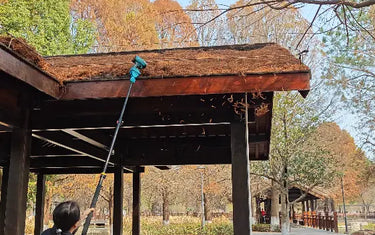
If you are struggling with low efficiency in leaf cleaning for yard maintenance or property management, always feeling arm soreness after long-time use by a handheld leaf blower, incomplete cleaning and fast power consumption, these 6 practical tips sorted out for you will greatly upgrade your experience with the pole battery leaf blower, helping you avoid repeated work and finish cleaning the whole area faster.
1. Adjust the Extension Pole in Sections for Stable & Labor-Saving Cleaning
Many beginners habitually stretch the extension pole to the longest length for all cleaning scenarios, which is the core reason for scattered wind power.
When the extension pole is overly extended, the distance between the nozzle and the cleaning target becomes too far, causing wind force dispersion. The correct skill is to adjust the pole length in sections according to the actual cleaning height.
Use a shorter pole for low eaves and ground cleaning, and extend the pole appropriately only for high roof and deep gutter areas. This segmented adjustment keeps the pole stable, concentrates wind power to the maximum extent, reduces arm vibration and fatigue, and achieves the fastest coverage cleaning effect with the pole battery leaf blower.

2. 45° Diagonal Blowing Method to Eliminate Gutter Residues
Vertical straight blowing is the most common wrong operation for gutter cleaning. Vertical high-pressure blowing easily presses sediment and wet leaves into gutter gaps, forming stubborn dirt residues that cannot be completely cleaned. The professional 45° diagonal blowing technique perfectly solves this problem.
By aligning the nozzle at a 45° angle with the gutter groove, the concentrated airflow can quickly scoop out internal sediment and dead leaves along the groove trend. This blowing method avoids compressing dirt into gaps, thoroughly cleans hidden corners of drainage channels, and ensures zero residual cleaning for all high-altitude gutter maintenance with your pole-style battery leaf blower.

3. Clean from Far to Near, High to Low to Avoid Repeated Work
Scattered leaves on large-area roofs are prone to flying randomly and falling back to cleaned areas if blown disorderly, leading to repeated cleaning and wasted time. The most efficient cleaning logic for large-area roof and yard scenes is layer-by-layer advancement from far to near and from high to low.
Start blowing from the farthest and highest roof area, gradually gather debris toward the near and low ground, and uniformly clean the concentrated leaves at last.
This standardized operation trajectory effectively prevents leaf flying back and cross-contamination, greatly improves the overall cleaning efficiency of the battery leaf blower, and completely avoids rework caused by irregular operation.

4. Leverage Long-Distance Blowing to Cross Obstacles Freely
Courts are usually equipped with ditches, flower beds, and green belts, forming isolated obstacle areas that are difficult for ordinary cleaning tools to handle. Traditional handheld leaf blowers require users to move positions frequently or use auxiliary tools to clean remote dead corners, which is extremely inefficient.
The extended pole advantage of the extension battery leaf blower supports stable long-distance blowing across obstacles.
Users can stand in a fixed position to clean leaves and dirt on the other side of ditches and flower beds without frequent movement or ladder assistance. It simplifies complex obstacle scene cleaning and saves a lot of time for yard maintenance.

5. Scientific Gear Control to Double Battery Endurance
Running the battery leaf blower at full high gear continuously is the main cause of rapid power consumption. Many users keep high wind speed throughout the whole cleaning process, which not only wastes electric energy but also causes excessive motor load.
The scientific power-saving skill is classified gear adjustment: use low gear for light floating leaves and surface dust cleaning, and switch to high gear only for compacted sediment and stubborn gap dirt. Adopt intermittent pulse blowing instead of long-time continuous blowing.
This flexible operation mode can double the battery endurance, realizing long-time whole-house cleaning with a single charge.

6. Low-Angle Downwind Blowing for Zero-Dust Cleaning
High-angle vertical strong blowing will cause a large amount of dust to fly randomly, adhering to windows, exterior walls, and flower beds, resulting in secondary pollution and repeated cleaning. The zero-dust cleaning trick is to follow the wind direction with low-angle flat blowing.
Adjust the nozzle to a low horizontal angle, blow along the natural wind direction, and let leaves and dust gather steadily in the designated area. This method controls the floating range of dust, protects the exterior wall paint and window glass, and realizes clean, tidy, and dust-free yard maintenance with the battery leaf blower.

Final Summary
The working efficiency of a pole battery leaf blower depends not only on equipment parameters such as wind speed and air volume but also on standardized operating skills.
By mastering segmented pole adjustment, 45° diagonal blowing, layered cleaning, obstacle crossing blowing, scientific gear control, and low-dust blowing skills, every homeowner can maximize tool performance, save time and battery power, and complete high-quality outdoor high-place cleaning easily.