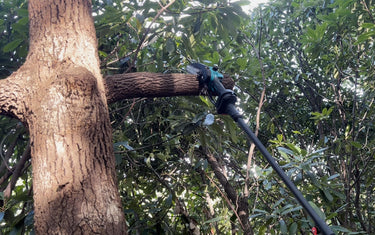
A cordless pole saw is one of the most essential tools for home garden maintenance, yard tree trimming, and light landscape work. The 6 inch mini cordless pole saw stands out for its lightweight design, adjustable telescopic rod, and great compatibility with small and medium tree branches. Compared with traditional hand saws and heavy electric saws, it is easier to operate, highly portable, and much safer for daily pruning. It handles both low dense branches and high out-of-reach limbs perfectly, making it ideal for amateur gardeners and household use.
However, many beginners struggle with common problems when using a cordless pole saw: labor-intensive low cutting, torn tree bark, rough cuts, and saw blade slipping during operation. These issues are rarely caused by poor tool quality, but by incorrect cutting habits and unstandardized operation methods.
This practical guide shares three core professional cutting skills for the 6 inch mini cordless pole saw. With these simple and effective techniques, you can make clean, smooth, and tree-friendly cuts without professional gardening experience.

1. Switch Cutting Modes for High and Low Branches (Handheld & Pole Mode)
The biggest advantage of a mini cordless pole saw is its dual-purpose design, which supports detachable handheld mode and extended pole mode. Many beginners make the mistake of using the extended pole for all trimming work. This leads to unsteady operation, inaccurate cutting, skewed notches, and blade jams, greatly reducing pruning efficiency.
Handheld Mode for Low Branches
For branches below 1.5 meters, dense undergrowth, and side branches close to the trunk, remove the telescopic pole and use the handheld mode. Low-growing branches usually grow in narrow and crowded spaces. Using a long pole in tight areas limits flexibility, easily scratches the main trunk, and affects pruning accuracy.
Handheld operation provides a firmer grip and higher flexibility. You can adjust the cutting position at close range to trim fine branches and shape trees precisely. The stable holding posture avoids blade offset caused by pole shaking, effectively reducing operation errors.
Pole Mode for High Branches
For branches above 1.5 meters or hard-to-reach high limbs, switch to the telescopic pole mode. This is the most valuable feature of a cordless pole saw. It allows you to trim tall branches safely on the ground without climbing ladders, completely avoiding the risk of falls and injuries during high-altitude pruning.
Stretch the pole to a proper length that keeps your body stable and the blade closely attached to the branch. Do not overstretch the pole to prevent shaking. Cut steadily with uniform force, relying on the sharpness of the blade instead of brute force. This ensures high efficiency while protecting the pole and blade for longer service life.

2. Double-Cut Method: 30% Bottom Pre-Cut to Prevent Bark Tearing
Bark tearing and trunk peeling are the most common problems when trimming thick branches with a cordless pole saw. Most people choose to cut straight down from the top in one go. Although this method seems time-saving, it causes great damage to trees. The weight of the branch will pull the bark downward at the moment of cutting through, resulting in large peeling wounds. These rough notches are not only unsightly but also prone to bacterial infection and rot, hindering tree growth and healing.
For branches with a diameter of 2 to 6 cm, the most effective anti-tear double-cut technique is: cut 30% of the branch from the bottom first, then cut through from the top.
Step 1: 30% Pre-Cut at the Bottom
Adjust the blade angle and make a shallow upward cut at the inner bottom of the branch, cutting only 30% of the branch thickness without cutting through. This shallow notch acts as a buffer lock for wood fibers, effectively preventing longitudinal tearing of the main bark when the branch falls.
Keep the pre-cut position 3 to 5 cm away from the main trunk to avoid damaging the tree’s healing layer and reserve enough space for wound recovery. Always cut gently and evenly to ensure a neat pre-cut notch.
Step 2: Full Cut from the Top
After finishing the bottom pre-cut, align the blade vertically above the pre-cut position and cut straight down until the branch is completely separated. The buffered bottom notch offsets the pulling force of the falling branch, leaving a smooth, burr-free, tear-free cut surface.
This double-cut method is compatible with all pruning scenarios of a 6-inch mini cordless pole saw, whether in handheld or pole mode. It perfectly balances pruning efficiency and tree protection.

3. Anti-Slip Cutting Skill: Vertical Cross Cut Instead of Diagonal Cut
Many new users tend to cut branches diagonally with a cordless pole saw, thinking diagonal cutting is labor-saving and faster. In fact, diagonal cutting easily causes blade slipping, offsetting, and derailing. It not only reduces cutting efficiency but also may scratch hands and damage the trunk, bringing potential safety hazards.
The root cause of slipping is incorrect cutting angles. The inclined contact surface of diagonal cutting leads to uneven force. The blade cannot firmly bite the wood fibers and slides sideways under slight pressure, resulting in skewed cuts and bent branches.
Standard Vertical Cross Cutting Posture
The golden rule for using a 6-inch mini cordless pole saw is to keep the blade vertically crossed at 90° with the branch. The vertical fitting state enables the saw teeth to bite wood fibers evenly and stably, completely avoiding slipping and offsetting.
No matter the branch is horizontal, vertical, or tilted, always fine-tune the pole angle to maintain a vertical cross state. This professional gardening technique is simple to operate with a high fault tolerance rate, suitable for all beginners.
Slipping Adjustment & Operation Details
Stop cutting immediately once slight slipping occurs. Do not press hard, which will aggravate slipping and deform the blade. Adjust the pole back to the vertical cross angle, fit the blade tightly with the branch, and continue cutting at a uniform speed.
In addition, do not apply excessive pressure during the whole process. The original sharpness of the mini cordless pole saw is enough for daily branch trimming. Light and steady pushing and pulling ensure smooth cuts and extend blade service life.
Final Summary & Beginner Tips
Mastering the three core techniques above allows you to operate a 6-inch mini cordless pole saw skillfully. You can easily complete professional yard pruning with neat cuts and fast tree healing, avoiding common pruning failures and tool misuse.
For daily maintenance, regularly check the blade sharpness and keep the saw teeth clean to ensure stable cutting performance at all times.
#jovant #CordlessPoleSaw #MiniPoleSaw #TreeTrimmingTips #AntiTearPruning #AntiSlipCutting #YardMaintenance #TelescopicPoleSaw