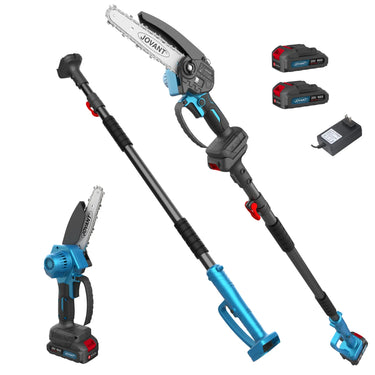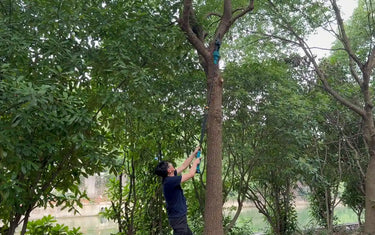
There are basically three ways to trim high branches. Each method can get the job done, but they differ hugely in terms of safety, effort, and precision. Today, let’s go through these three methods one by one—climbing the tree, using a ladder, and using a pole saw—and you’ll see why an upgraded tool, the powered pole saw, is quietly rewriting the way we handle outdoor maintenance.

Method 1: Climbing the tree to prune
Armed with a hand saw or chainsaw, you climb right into the canopy to work — this is the old-school approach. For a professionally trained arborist secured with ropes and a safety harness, it may be manageable. But for the average homeowner, climbing into a tree means confronting a series of very real risks.

Advantages:
- You can get up close to every branch, allowing for precise cuts.
- No need to invest in additional long-reach tools.
Disadvantages:
- Falls are one of the leading causes of home accidents. Without professional climbing gear and a ground crew to assist, even a small misstep can result in a serious incident.
- Branches you are not cutting may snap unexpectedly, and dead limbs can suddenly break under your body weight.
- It is extremely physically demanding. Trimming several high branches means repeatedly climbing up, constantly fighting for balance, and continuously wielding a sharp blade — leaving you utterly exhausted by the end.
Method 2: Using a ladder
A ladder seems safer and more civilized than climbing a tree — a step up, so to speak. For jobs like working near the eaves of a house, a ladder can just about get the job done. But the moment you angle the ladder deep into the canopy and start looking up to saw off branches, that sense of safety quickly evaporates.

Advantages:
- Compared to scrambling up a tree trunk, setting up a ladder is simpler, especially when the lower part of the trunk is straight and clear of side branches.
- It frees up both hands so you can use whatever cutting tool you are most comfortable with.
Disadvantages:
- A ladder placed on soft or uneven ground is extremely prone to wobbling. Add a light breeze that stirs the branches, and whatever stability you had collapses entirely.
- You are forced to work directly beneath the branch you are targeting. This means sawdust, broken twigs, and even the entire limb come straight down toward your face.
- Reaching sideways from a ladder to make a cut can easily shift your centre of gravity beyond the point of support. Overreaching is a fast ticket to a fall.
- After every single branch, you have to climb down, move the ladder, and climb back up. On a medium-sized tree with many high limbs, repeating this a few times can eat up an entire day.
Method 2: Using a ladder
A ladder seems safer and more civilized than climbing a tree — a step up, so to speak. For jobs like working near the eaves of a house, a ladder can just about get the job done. But the moment you angle the ladder deep into the canopy and start looking up to saw off branches, that sense of safety quickly evaporates.
Advantages:
- Compared to scrambling up a tree trunk, setting up a ladder is simpler, especially when the lower part of the trunk is straight and clear of side branches.
- It frees up both hands so you can use whatever cutting tool you are most comfortable with.
Disadvantages:
- A ladder placed on soft or uneven ground is extremely prone to wobbling. Add a light breeze that stirs the branches, and whatever stability you had collapses entirely.
- You are forced to work directly beneath the branch you are targeting. This means sawdust, broken twigs, and even the entire limb come straight down toward your face.
- Reaching sideways from a ladder to make a cut can easily shift your centre of gravity beyond the point of support. Overreaching is a fast ticket to a fall.
- After every single branch, you have to climb down, move the ladder, and climb back up. On a medium-sized tree with many high limbs, repeating this a few times can eat up an entire day.
A ladder delivers you directly into the danger zone: your feet are off the ground, your balance is precarious, and you are craning your neck while straining to saw overhead. You can trim high branches this way, but your back and your frayed nerves will keep reminding you — there must be a smarter way.
Method 3: Using a pole saw (especially a powered one)

This is the tool that genuinely breaks the deadlock. A pole saw, as the name suggests, is a pruning saw mounted at the end of a telescopic pole, allowing you to stand firmly on the ground and reach branches four or five metres overhead, or even higher. A manual pole saw relies entirely on arm strength — you cut by yanking the blade back and forth with brute force, and it soon becomes an exhausting physical chore. What truly brings a revolution is the powered pole saw.
A powered pole saw keeps the long-reach design but adds a battery-driven motor or a small petrol engine. Instead of sawing back and forth for several minutes to remove a single branch, you just position the guide bar and chain against the limb, squeeze the trigger, and the tool does the cutting for you. The cut is crisp, almost startlingly fast — and deeply satisfying.
Why a powered pole saw comes out on top:
- Your feet stay on the ground. No ladder, no tree climbing. You stand solidly on the earth, in full control the entire time.
- It is much faster. A branch that takes three minutes to saw through with a manual pole saw can be dealt with in maybe ten seconds with an electric model.
- Less fatigue, safer cutting. Your arms are no longer shaking and trembling from exertion, so you can focus on precision and on reading the bigger picture — watching for power lines, uneven ground, and other surrounding hazards.
- Cleaner cuts, healthier trees. The high-speed electric chain reduces tearing and pulling, leaving a smooth wound that the tree can seal and heal more effectively on its own.
- The length adjusts to your needs. Most powered pole saws extend in sections, completely eliminating the danger of “stretching just a bit further.” You set the length, lock it in place, and then make the cut calmly and deliberately.